One audience, three bots: how 1,358 users became 2,903 subscriptions
I started with one simple chatbot that sent out free tips on a schedule. It sold nothing — its only job was to deliver free content and keep the audience warm.
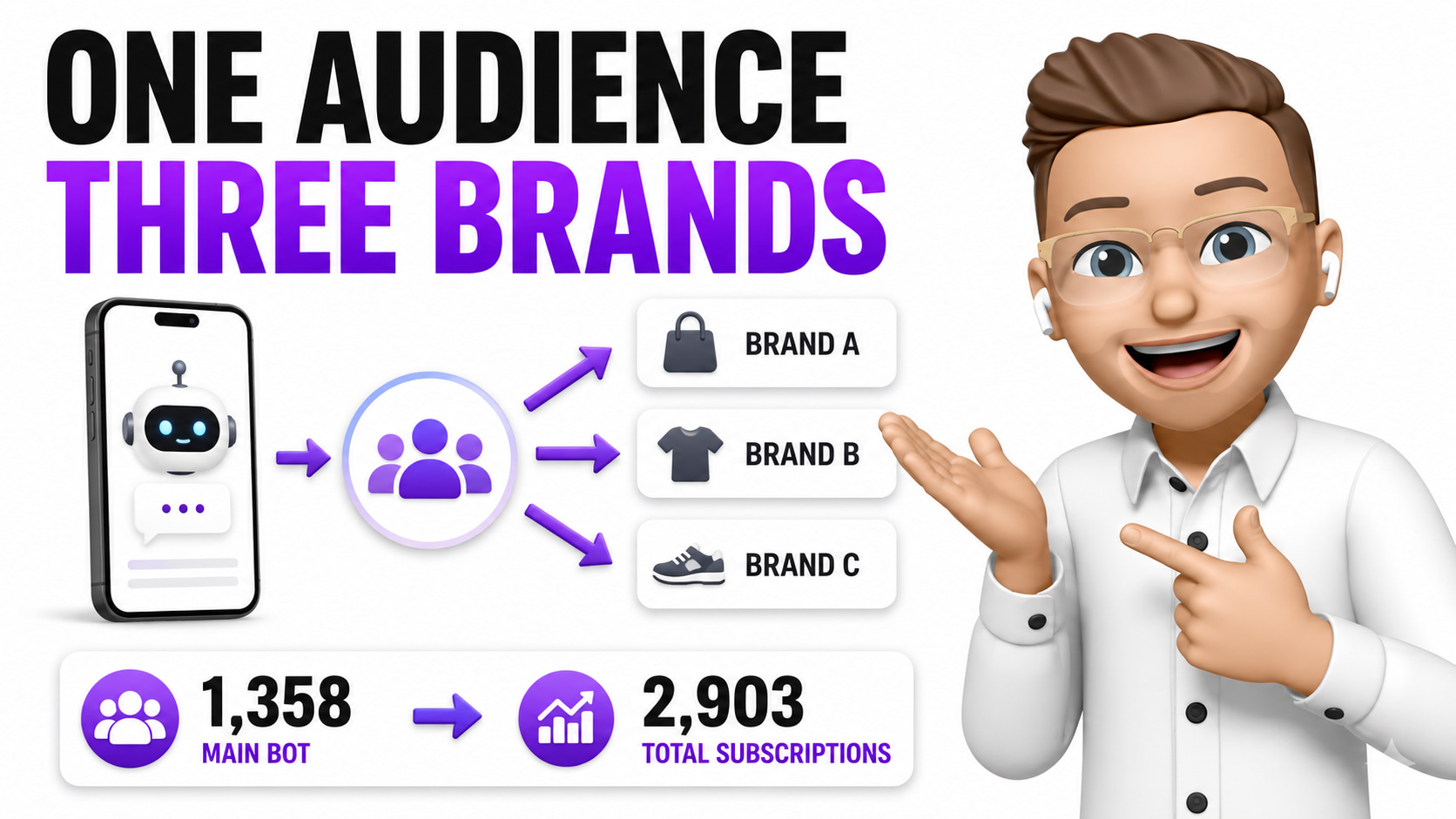
Over time it collected 1,358 users. Rather than start bolting sales offers onto that same bot, I decided to use the audience differently: I launched two separate sales projects and brought users over from the main free bot with targeted campaigns.
The result was 2,903 subscriptions across three bots — and one surprise: people who never bought anything in the first sales project started buying in the second.
Where the whole thing started
The main bot worked as the central place for the whole audience. People joined for the free tips and kept coming back because they knew new content was coming for free. That's exactly why they stayed active without me having to hit them with sales messages every day.
I could of course have started selling everything right there in that bot. But it would have changed its purpose fast — a bot with free content would have turned into another sales channel full of ads. So I left it as a source of free content, and as the place I could promote other projects from.
Why I didn't want to sell everything under one brand
I used to run into the same problem over and over. Someone joins for one kind of content, and gradually starts receiving several different offers, ads for other projects and repeated calls to buy. They didn't always leave because the content stopped interesting them. Often they simply got tired of the volume of irrelevant messages.
On top of that, I didn't want one project selling everything at once. One bot was to offer free tips, the second was to work as a standalone sales project, and the third was to have its own brand, its own voice and its own offers. That way each project could stay simpler and focus on its own way of selling.
I launched two separate sales bots
Alongside the main free bot I created two new projects. The structure came out like this:
Main bot with free tips
→ Sales bot A
→ Sales bot B
Each sales bot had its own name, its own profile picture, its own tone and its own daily offers. But the new projects didn't have to find their first users from nothing — I introduced both, gradually, to an audience that was already active in the main bot.
Those people already knew my content, opened messages regularly and knew what to expect. So a new project didn't start with an empty audience.
How I promoted the projects without pointless spam
I promoted the new bots with campaigns in TG Flows. But I didn't want to keep sending the same message to everybody. If someone already followed sales bot A, there was no sense in asking them again to join it.
So I used segmentation in every campaign. When I promoted sales bot A, I excluded the users who already followed it. Promoting sales bot B worked the same way.
That way every follow-up campaign only reached people it was still relevant to. Which meant I could remind people about the new projects more than once without hammering the whole audience with the same ad.
What splitting the audience produced
The main free bot originally had 1,358 users. A handful of targeted campaigns later, I had:
- 867 users in sales bot A
- 791 users in sales bot B
- 1,245 users still in the main free bot
867 + 791 + 1,245 = 2,903 subscriptions across three bots
These aren't 2,903 unique people — some users follow two of the projects, or all three. That was never the point.
I wasn't trying to inflate a headcount. I wanted to turn one existing audience into several separate channels, each with its own brand, content and way of selling — without having to build every new project from scratch.
It wasn't only the subscriber count that went up
The most interesting result didn't show up in follower numbers, but in purchases. Across all the sales projects I offered the same genuinely analysed accumulator tickets, mostly at odds of roughly 5 to 10+.
So it wasn't that one project sold a better product than the other. And yet the same people responded to the two projects completely differently.
Some users had been active in the first sales bot for a long time. They opened messages, watched the offers and stayed subscribed — but never bought anything. When I brought those users into the second project, some of them suddenly started buying.
Same product, different surroundings
Honestly, I can't tell you exactly why their behaviour changed. It could have been a different project name, a different profile picture, a different tone, a different way of presenting the offer — or the second project's brand simply suited them better.
Either way, the result was clear. People who would probably never have bought in the first project started generating revenue in the second.
That mattered more to me than the rise in subscriptions.
The problem isn't always the product or the audience. Sometimes a particular person just doesn't click with the brand, or with the way the offer is put to them. In a second project, the same user can react completely differently.
What this taught me
The same audience won't necessarily react the same way to every brand. Someone who never buys in one bot can be a regular customer in another.
TG Flows lets me introduce new projects to an audience I already have, while making sure people don't get ads for bots they already follow.
The whole system is simple:
The main bot sends free content regularly
→ the audience stays active
→ I launch a new standalone project
→ a targeted campaign introduces it to the relevant users
→ I exclude anyone who already follows the new project
→ the new bot gets its first audience without starting from zero
→ some of those users start buying in the new project
The result:
- 1,358 users to begin with
- 2,903 subscriptions across three bots
- fewer repeated ads
- less churn out of the main bot
- faster starts for new projects
- purchases from people who never bought in the original project
So I plan to keep adding projects. But not just to create more bots and push the same audience into all of them. Every new project has to have its own brand, its own voice and a clear reason for someone to follow it.
That's when using one audience for several projects makes the most sense.